Security Modernization of a Business-Critical Enterprise Application
Transforming a legacy enterprise application into a secure, resilient, Zero Trust architecture.
Company
Informa
Industry
Enterprise / Multi-vertical
Cloud Platform
AWS
SECURITY APPROACH
Zero Trust / Defense-in-Depth
Enterprise Application ModernizationScroll to explore ↓
Executive Summary
Executive Summary
Many large enterprises rely on legacy web applications that were designed before modern cloud security principles became standard. As cyber threats evolve, these platforms often expose organizations to significant risk due to flat network topologies, permissive access controls, and unsecured deployment practices.
This case study details the comprehensive security modernization of a monolithic, business-critical enterprise application. By redesigning the network architecture, enforcing strict identity controls, securing the CI/CD pipeline, and implementing robust data protection mechanisms, the organization successfully transformed a vulnerable legacy system into a hardened, Zero Trust environment.
Business Challenge
Business Challenge
The enterprise relies on a critical web platform hosted on standard cloud infrastructure. Over time, operational convenience have taken priority over security, leading to severe vulnerabilities:
Perimeter Weakness: The application could be directly exposed to the internet with minimal filtering, making it highly susceptible to volumetric attacks and application-layer exploits.
Flat Network Architecture: Compute nodes and databases resided in the same network segments. A compromise of a public-facing web server could allow an attacker to traverse directly to the database.
Insecure Deployments: Deployment pipelines relied on hardcoded credentials and lacked automated security scanning, risking the introduction of vulnerabilities into production.
Over-privileged Access: Applications connected to databases using highly privileged, shared service accounts, increasing the potential impact of a SQL injection attack.
Objective
Objective
The goal was to overhaul the application’s security posture without disrupting ongoing business operations. Key objectives included:
Overhaul Software and Tools:Review the list of software and libraries in use on servers, server images (AMIs, Dockerfiles etc.), scan for vulnerabilities, classify the vulnerabilities based on the impact that they may have if exploited. Apply patches, library upgrades and code fixes to address them. Remove tools and libraries not used to minimize the attack surface area.
Perimeter Hardening: Implement enterprise-grade edge security to filter malicious traffic before it reaches the cloud provider.
Network Micro-segmentation:Isolate the application into distinct tiers to prevent lateral movement.
DevSecOps Integration: Build a secure, automated CI/CD pipeline with continuous vulnerability scanning and dynamic secrets management.
Data Protection & Secure Migration: Encrypt all sensitive data at rest and in transit, and establish secure data transfer protocols.
Identity-First Security:Enforce the principle of least privilege across all human and machine identities.
Security Strategy
Security Strategy
The modernization effort was driven by a Defense-in-Depth strategy:
01
Edge Defense
Deploying a Web Application Firewall (WAF) and Content Delivery Network (CDN) to manage all public ingress, providing DDoS mitigation and bot management.
02
Tiered Isolation
Utilizing private virtual networks to ensure only authorized load balancers can communicate with the application tier, and only the application tier can reach the database.
03
Shift-Left Security
Integrating security checks directly into the developer workflow to catch vulnerabilities before code is compiled.
04
Continuous Auditing
Ensuring every API call, infrastructure change, and login attempt is logged immutably for threat detection and compliance.
Edge Security (Cloudflare)
Edge Security (Cloudflare)
01
Rate Limiting
Protect origin servers from DDoS attacks, API abuse, and brute-force attempts by capping request rates from specific IP addresses. Define thresholds based on HTTP headers, query parameters, or session identifiers to control costs on expensive API calls.
02
Bot Management
Utilize machine learning models trained on vast internet traffic to instantly detect and mitigate novel automated attacks. Secure login endpoints from credential stuffing and defend APIs against inventory hoarding and scraping without adding latency for real users.
03
Zero Trust Access
Replace legacy VPN infrastructure with identity-aware Zero Trust access to strictly secure internal private resources.
Cloud Infrastructure Security (AWS)
Cloud Infrastructure Security (AWS)
01
Security Hub and Config
Enable the AWS Foundational Security Best Practices standard to automatically assess resource configurations across accounts. Leave the AWS CIS Foundations standard check enabled, which utilizes service-linked AWS Config rules to monitor compliance across all regions.
02
Identity and Access Management (IAM)
Separate data entry and review by using distinct IAM roles for AWS KMS encryption and decryption operations. Routinely reevaluate IAM permissions using Security Hub or open-source tools to identify and remove unused roles.
03
Threat Detection
Establish an Amazon GuardDuty master/member hierarchy to continuously monitor all regions and accounts for unauthorized behavior. Centralize AWS CloudTrail logs to ensure robust data access for investigating unexpected environmental changes.
Code Security (DevSecOps)
Code Security (DevSecOps)
Static Analysis (SAST): Integrate Static Application Security Testing into the developer workflow to identify code vulnerabilities proactively before builds occur.
Software Composition Analysis (SCA): Automate the scanning of third-party dependencies in CI/CD pipelines to detect and mitigate known Common Vulnerabilities and Exposures (CVEs).
Secret Detection:Actively scan source code and commits to prevent hardcoded API keys, tokens, and credentials from entering repositories.
Infrastructure as Code (IaC) Scanning: Evaluate Terraform, CloudFormation, and Kubernetes manifests against custom security policies to prevent cloud misconfigurations prior to deployment.
Server Security Hardening
Server Security Hardening
Operating System Baselines: Measure current server states against established CIS, STIG, or vendor baselines. Remove optional packages, disable unused services, and close unnecessary listening ports to reduce the attack surface.
Access and Authentication: Enforce strict SSH key and cipher policies, restrict sudo and PAM scope, and mandate Network Level Authentication (NLA) for Windows RDP. Implement Multi-Factor Authentication (MFA) on administrative paths and define break-glass emergency procedures.
Kernel and Runtime Defenses: Apply secure sysctl rules, enforce AppArmor or SELinux profiles, and configure AppLocker or WDAC for Windows servers. Restrict kernel modules and set /tmp and /var mount points to noexec to prevent unauthorized script execution.
Deployment Security
Deployment Security
Pipeline Integration: Shift security from a final pre-release gate to a continuous, automated process embedded entirely within the CI/CD lifecycle. Treat application security as a shared responsibility across development and operations teams.
Container Hardening: Scan container images with specialized tools before deployment. Enforce Pod Security Standards and configure admission controllers within Kubernetes environments to establish secure container build practices.
Automated Enforcement: Tune security scanning tools to reduce developer friction from false positives, and ensure automated deployments satisfy strict compliance requirements like PCI DSS and SOC 2.
Infrastructure Security Architecture
Infrastructure Security Architecture
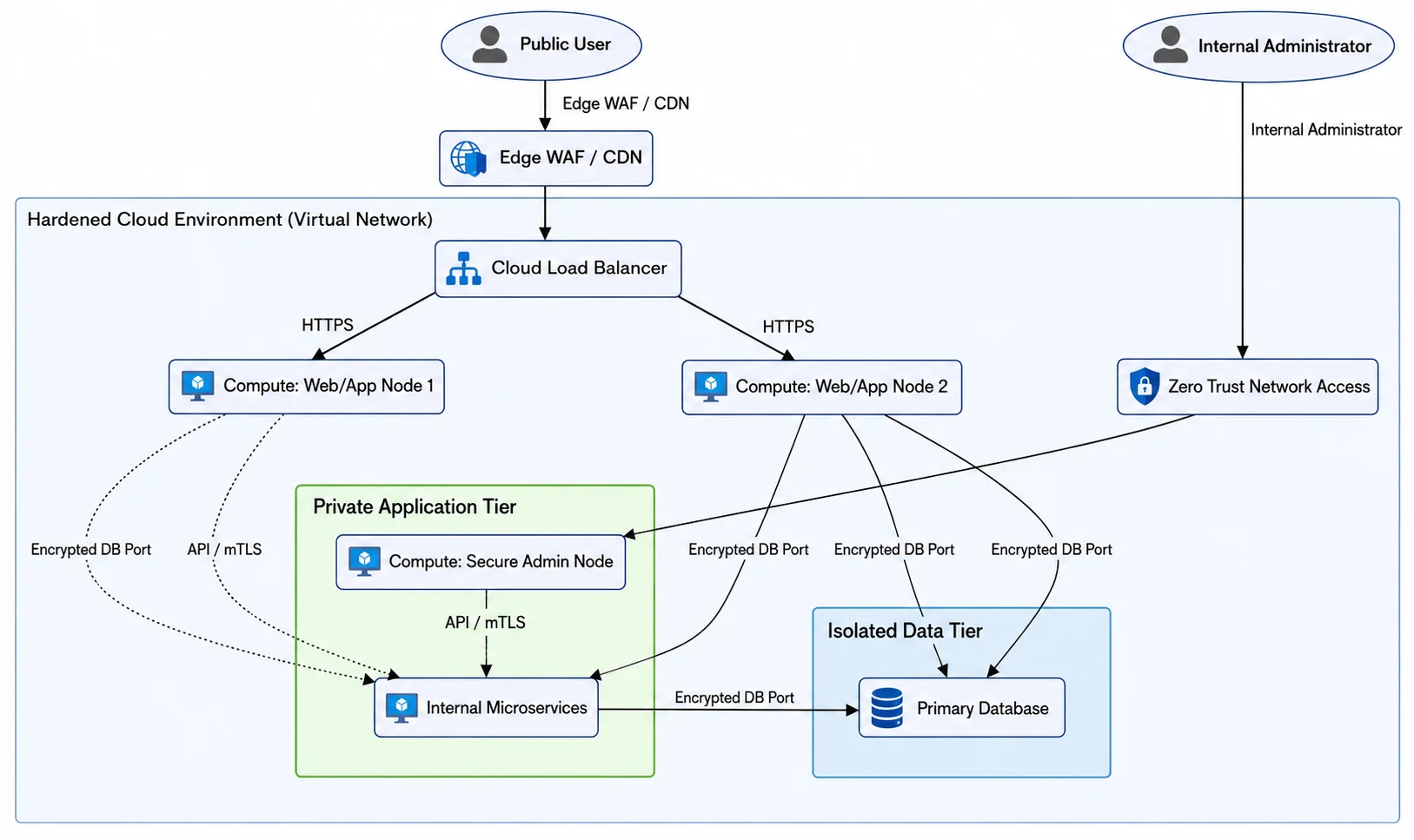
The infrastructure can be designed into a strict three-tier virtual network model.
Public Tier: Only the Load Balancer exists in a public-facing subnet. It drops any traffic not originating from the Edge WAF.
Application Tier: Web and application servers operate in private subnets with no outbound internet access (egress filtering). Administrative interfaces are strictly segregated onto dedicated nodes accessible only via Zero Trust Network Access (ZTNA).
Data Tier: Databases are isolated in the deepest network layer, protected by strict network security groups that only permit database protocols from specific application-tier interfaces.
Data Protection & Secure Migration
Data Protection & Secure Migration
Securing the data layer required both architectural changes and careful operational execution.
Encryption Standards: All databases and attached storage volumes were encrypted at rest using centrally managed cryptographic keys. Transport Layer Security (TLS 1.2+) was enforced for all internal service-to-service communication.
Access Control Overhaul: Over-privileged accounts were replaced with dedicated, least-privilege service accounts bound to specific application roles.
Secure Data Migration: During the infrastructure upgrade, large-scale data and asset migrations were required. Rather than using automated zip compression scripts—which can create vulnerable temporary files and strip permissions—the team executed the migration using secure, manual folder mirroring over internal network protocols. This approach bypassed intermediary storage vulnerabilities and guaranteed that granular, file-level access controls remained strictly intact on the new architecture.
Regular Security Aspects
Regular Security Aspects
Post-deployment, the organization established continuous security operations:
Automated Patching: Implementing a rolling update strategy for OS and application dependencies to ensure zero downtime during monthly security patching.
WAF & Threat Intel: Continuously tuning WAF rules based on active threat intelligence feeds to block emerging zero-day exploits.
Centralized Logging (SIEM): Aggregating network flow logs, application events, and infrastructure audit trails into a centralized system to detect anomalous behavior in real-time.
Conceptual Tooling Matrix
Conceptual Tooling Matrix
CategoryPurpose in Architecture
Edge Protection
WAF, DDoS mitigation, malicious bot filtering, and global SSL termination.
Identity & Secrets
Cryptographic key management, dynamic secret injection, and SSO integration.
Network Security
Micro-segmentation, egress filtering, and Zero Trust access gateways.
Data Security
Transparent database encryption, storage volume encryption, and secure file transfer protocols.
DevSecOps
Automated pipeline orchestration, SAST/SCA scanners, and immutable artifact registries.
Security Best Practices Establishment
Security Best Practices Establishment
01
Assume Breach
The architecture is designed under the assumption that the perimeter can be bypassed, relying on internal micro-segmentation to prevent an attacker from expanding their footprint.
02
Least Privilege Enforcement
Every component, user, and automation script is granted only the minimum permissions necessary for its specific function.
03
Immutable Auditing
All changes to the cloud environment and database access attempts are recorded in tamper-proof audit logs.
04
No Direct Internet Management
All administrative ports (SSH, RDP) and management dashboards are entirely hidden from the public internet, requiring strict identity verification to access.

 OpenAI
 Gemini
 Anthropic
 DeepSeek
 Perplexity